
 Personal Account


 Личный Кабинет

Plant for the manufacture of metal granules "Granula-2500"

Plant for the manufacture of metal granules "Granula-2500"
Description
The plant "Granula-2500" for the manufacture of granules and powders of heat-resistant nickel alloys and titanium alloys
 Detailed information PDF

The granule manufacture plant “Granula-2500” is designed for the production of powders of heat-resistant nickel alloys and titanium alloys by plasma spraying of a rotating workpiece in an inert gas environment with simultaneous transportation of the powder into a sealed container..
The plant consists of:
- Spray chamber;
- Sliding door;
- Loading unit;
- Drive unit;
- Vacuum system;
- Bayonet shutter;
- Rail tracks;
- Metal structure;
- Pit with supporting metal structure;
- Gas system;
- Water-cooling system;
- Rectifier «VPU-2500M»;
- Container;
- Control system;
- Workpiece-end collection mechanism;
- Electrical wiring;
- Bunker of substandard granules;
- Pneumatic system;
- Service area.
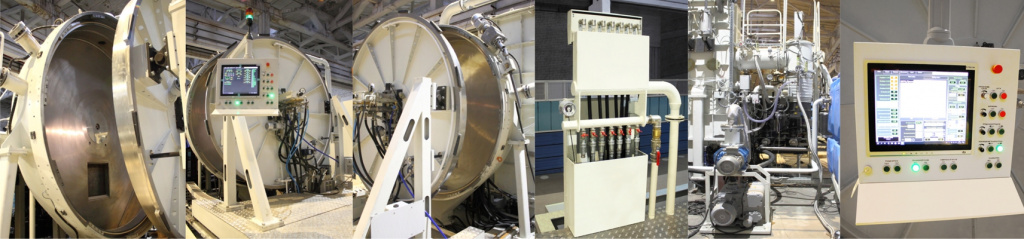
The manufacture of metal powders using the "Granula-2500" plant is based on the method of centrifugal spraying of the melt from the end of a rod blank, melted by a plasma jet. Melt drops separated from the rotating workpiece, moving in an inert environment, cool at a speed of 104 - 107 °С/sec, forming metal particles - powder, which moves from the spray chamber to the receiving container. In the container, the metal powder is sealed in the inert environment in which it was produced. The container is disconnected from the spray chamber and transferred for further processing. At the first stage of particle formation, until it is separated from the crown, there is practically no interaction between the particle and the gaseous medium. Consequently, the appearance of particles with gas and other inclusions is excluded. Cooling and crystallization in a mixture of inert gases occur in the second stage. At a crystallization rate above 103 - 104 °С/s, particles with a fine-grained structure are formed. With an increase in the cooling rate, the dispersion of the microstructure of the powder particle increases, which is associated with a change in the conditions of crystal growth. The granulometric composition of the resulting powder can be adjusted by changing the rotation speed of the workpiece.
The most important parameters influencing the cooling rate of a crystallizing powder particle are the diameter of the particle, the thermal conductivity of the gas mixture, and the pressure in the atomization chamber. The ability to regulate these parameters during centrifugal atomization of the melt and, consequently, control the cooling rate of metals and alloys opens up great opportunities for the formation of particles with a predictable structure and properties. The rate of crystal nucleation increases with increasing cooling rate, which leads to a proportional decrease in grain size. At a heat removal rate above 102 - 104 °С/s, all structural components of the alloy are sharply crushed, and the physical density of an individual particle increases compared to cast metal.
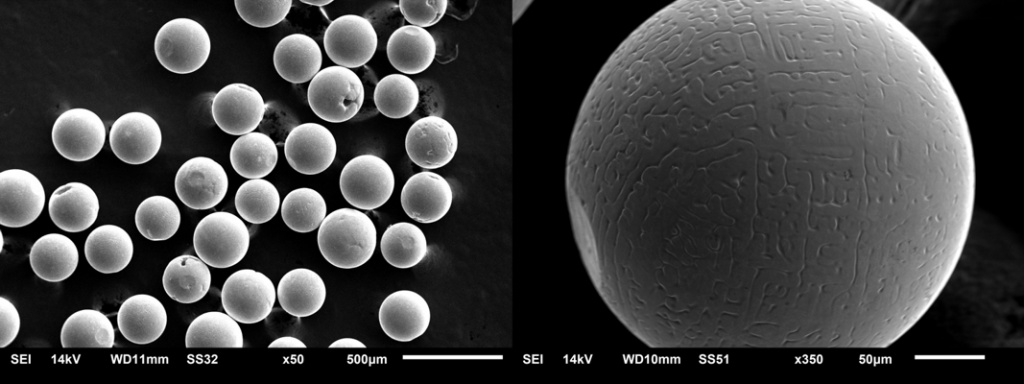
Sputtering at a particle cooling rate of up to 10-4 °С/s, as a rule, leads to the formation of microcrystalline and dendritic structures. When a drop is supercooled, a spherical powder with a non dendritic structure can be obtained. The cooling rate of particles can be increased by additional convective cooling. When cooling at a rate above 103 - 104 °C/s, particles with a dispersed microcrystalline and fine dendritic structure are formed.
The plant consists of:
- Spray chamber;
- Sliding door;
- Loading unit;
- Drive unit;
- Vacuum system;
- Bayonet shutter;
- Rail tracks;
- Metal structure;
- Pit with supporting metal structure;
- Gas system;
- Water-cooling system;
- Rectifier «VPU-2500M»;
- Container;
- Control system;
- Workpiece-end collection mechanism;
- Electrical wiring;
- Bunker of substandard granules;
- Pneumatic system;
- Service area.
The manufacture of metal powders using the "Granula-2500" plant is based on the method of centrifugal spraying of the melt from the end of a rod blank, melted by a plasma jet. Melt drops separated from the rotating workpiece, moving in an inert environment, cool at a speed of 104 - 107 °С/sec, forming metal particles - powder, which moves from the spray chamber to the receiving container. In the container, the metal powder is sealed in the inert environment in which it was produced. The container is disconnected from the spray chamber and transferred for further processing. At the first stage of particle formation, until it is separated from the crown, there is practically no interaction between the particle and the gaseous medium. Consequently, the appearance of particles with gas and other inclusions is excluded. Cooling and crystallization in a mixture of inert gases occur in the second stage. At a crystallization rate above 103 - 104 °С/s, particles with a fine-grained structure are formed. With an increase in the cooling rate, the dispersion of the microstructure of the powder particle increases, which is associated with a change in the conditions of crystal growth. The granulometric composition of the resulting powder can be adjusted by changing the rotation speed of the workpiece.
The most important parameters influencing the cooling rate of a crystallizing powder particle are the diameter of the particle, the thermal conductivity of the gas mixture, and the pressure in the atomization chamber. The ability to regulate these parameters during centrifugal atomization of the melt and, consequently, control the cooling rate of metals and alloys opens up great opportunities for the formation of particles with a predictable structure and properties. The rate of crystal nucleation increases with increasing cooling rate, which leads to a proportional decrease in grain size. At a heat removal rate above 102 - 104 °С/s, all structural components of the alloy are sharply crushed, and the physical density of an individual particle increases compared to cast metal.
Sputtering at a particle cooling rate of up to 10-4 °С/s, as a rule, leads to the formation of microcrystalline and dendritic structures. When a drop is supercooled, a spherical powder with a non dendritic structure can be obtained. The cooling rate of particles can be increased by additional convective cooling. When cooling at a rate above 103 - 104 °C/s, particles with a dispersed microcrystalline and fine dendritic structure are formed.
Technical data
Supply voltage, V
400
Rated frequency, Hz
50±0.2
Phases
3
Installed power, kW
300
Chamber diameter, mm
2500
Melting unit capacity, kg/hour
90
Maximal quantity of loaded workpieces of titanium/heat resistant nickel alloys, pcs.
100/70
Workpiece material
titanium/heat resistant nickel alloys
Dimensions of sprayed titanium workpiece (Ø*Length), mm
(55-1)*(700-1)
Dimensions of the sprayed workpiece of heat-resistant nickel alloys (Ø*Length), mm
(80-1)*(700-1)
Maximum rotation speed of titanium/nickel workpiece, rpm
40000 / 30000
Drum rotation drive
from electric spindles to drums
Number of drums, pcs.
2
Working vacuum, mm Hg.
5*10-5
Leakage, l.µm.Hg/s
15
Pumping time to operating residual pressure with prepared diffusion pump, min.
60
Gas environment
mixture of Ar+He gases in the ratio ~1:9
Water supply system
double-circuit closed
Water pressure in the heat exchangers of the installation, MPa
0,2 - 0,4
internal circuit water used
softened, distilled
Air pressure in the pneumatic system, MPa
0,4 - 0,6
Power supply type
VPU-2500M
Overall dimensions, mm, (L*W*H)
9400*8000*6260
Масса, кг
24000
Detailed information PDF
Submit an inquiry
Прошлое
Настоящее
Будущее