
 Personal Account


 Личный Кабинет

Vacuum induction melting and pouring plant "UPPF"

Vacuum induction melting and pouring plant "UPPF"
Description
Vacuum induction plant "UPPF" for casting products from heat-resistant alloys
 Detailed information PDF

1. Purpose. Used technological processes.
The vacuum induction unit "UPPF" is designed for casting products from heat-resistant alloys in serial production conditions and for testing complex technologies in pilot production.
The vacuum induction melting and pouring plant of the "UPPF" type is designed to manufacture ingots and cast billets from high-alloy low-carbon steel grades, precision alloys, as well as non-ferrous metals using the lost wax casting method.
The principle of operation of vacuum induction melting is to carry out the process of melting of the alloy in a high vacuum or in a protective atmosphere of inert gases with a solid charge. The melting block - the inductor and the crucible are located in a vacuum melting chamber, where a vacuum of the required degree is created using special vacuum pumps. An atmosphere of inert gases can be created in the melting chamber if necessary.
Vacuum induction melting technology makes it possible to produce high-purity alloys with low carbon content. The presence of a vacuum environment promotes the process of degassing and refining of the melt. Induction mixing allows you to achieve uniform chemical composition, rapid dissolution of alloying elements and homogeneity.
The resulting alloy has a minimum content of gases, non-metallic inclusions, impurities and a uniform chemical composition.
2. Features of the physical processes used.
The induction principle of operation of the “UPPF” plant allows the melting of both magnetic and non-magnetic alloys. Induction mixing of the melt has a beneficial effect on the melting process. The furnace has versatility in the use of various crucibles; depending on the technological need, it is possible to use replaceable ceramic, printed and graphite crucibles.

3. Plant design.
Vacuum induction melting and pouring plant of the “UPPF” type consists of the following functional blocks:
1. Melting chamber.
2. Loading chamber.
3. Melting block, consisting of an inductor and a crucible.
4. Induction furnace rotation mechanism.
5. Loading device.
6. Mold heating oven.
7. Technological shutter.
8. Vacuum system.
9. Water cooling system.
10. Control system.
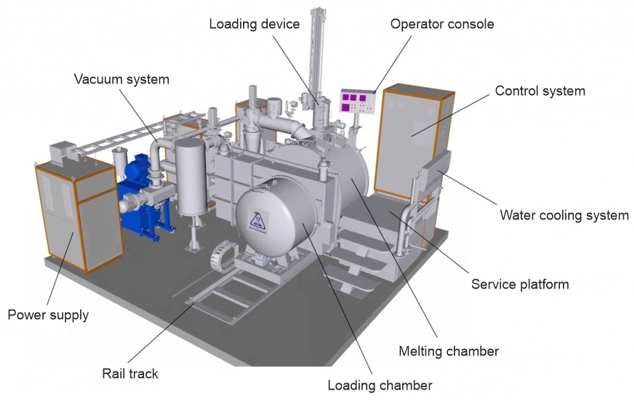
The melting chamber is the main element of the plant in which the process of melting metal and pouring it into hot molds takes place. An induction furnace is installed in the melting chamber. The melting and pouring processes are monitored through observation windows. The loading device is mounted on the upper flange of the melting chamber. The melting chamber is connected to the loading chamber through a slide gate. Molds for pouring are fed from the loading chamber into the melting chamber.
The loading chamber is a welded structure with water cooling. The loading chamber moves along a rail track using an asynchronous motor, gearbox and chain drive.
An induction melting furnace is designed to melt metal and pour it into shell molds. The furnace is mounted in the melting chamber on a rotating bracket. It consists of upper and lower plates, an inductor and magnetic circuits.
The rotation mechanism of the induction furnace ensures that liquid metal is poured from the crucible into heated molds. The reversible mechanism for turning the crucible with smooth speed control is assembled from an asynchronous motor with a gearbox and a frequency drive.
The loading device consists of a welded box-type body and a vacuum-sealed door. Two rods carrying a loading cup and an immersion thermocouple are placed in the device body.
The loading device has two separate drives - one for supplying a container with a charge, the second - a quick-release immersion thermocouple and a two-wave pyrometer.
The mold heating oven ensures the temperature conditions of the molds supplied for pouring. It has two adjustable heating zones along the vertical axis.
The slide-type technological gate is designed for vacuum separation of the melting and loading chambers. It consists of a water-cooled welded body and a movable damper (gate). When the valve operates, the sealing flap slides along the guides. The movement of the damper is carried out by a pneumatic cylinder. Vacuuming of the shutter is carried out together with the airlock chamber.
The vacuum system of the plant consists of two lines: fore-vacuum and booster pumping. The booster line consists of a booster pump and a mechanical pump. The forevacuum mode is implemented on the basis of a Roots pump and a mechanical pump and is equipped with a mechanical filter.
The water cooling system consists of a pressure-drain manifold of water control sensors, valves, pressure gauges and pipelines. The unit could be equipped with a reverse water cooling system optionally.
The control system includes a computer for collecting and processing information about the vacuum casting process, and a set of remote input-output modules for monitoring and recording parameters of the vacuum induction melting process.
The control system has light and sound alarms about process deviations and plant malfunctions, and the system's measuring equipment provides control of temperature, pressure, and electrical parameters.
The control system software allows you to visualize the elements of the technological system, display the numerical values of the process parameters, data archiving, and keep a log of events, errors and emergency situations.
3.2. Description of the plant operation.
Prepared and weighed calculated composition of the charge materials is loaded into the furnace crucible, and the poured mold or mold is installed in the mold heating furnace. Both chambers are closed, creating the required degree of vacuum.
The RF current source is turned on, and the melting process is carried out according to the technology.
After the melting process is completed, by turning the crucible to drain, the process of pouring liquid metal into a mold or mold occurs with the gate open between the melting chamber and the loading chamber, then the gate is closed.
While the process of cooling and crystallization of the melt in the mold or mold in the loading chamber is taking place, the melting chamber is opened and the charge is loaded for the next melt (the process of loading the charge is possible without opening the melting chamber through the loading device). The next melting process begins.
The loading chamber is opened after the cooling time defined by the technology, the filled mold is removed from the mold heating oven, and a new one is installed. The lid of the loading chamber is closed, the atmosphere in the loading chamber is pumped out and the gate device is opened. The cycle repeats.
The use of two chambers - melting and loading, as well as a gate valve between them, allows you to achieve high productivity and use the “UPPF” furnace in serial industrial production.
3.3. Advantages of vacuum induction plants "UPPF".
The vacuum induction melting and pouring plant is made on a modern element base with improved technical characteristics, which made it possible to increase the efficiency of the plant, make maintenance convenient, reduce operating costs (consumption of electrical energy, water, air per 1 kg of liquid metal), and most importantly, improve the quality of the melted metal.
Main advantages:
1. The ability to effectively control the state of the melt and its temperature throughout the entire melting process.
2. Purity of the resulting alloy in terms of gases and non-metallic inclusions.
3. Increased performance due to fast heating and two-chamber design.
4. High homogeneity and uniformity of chemical composition.
5. Any form of raw materials (lumpy materials, briquettes, powder, etc.)
6. High efficiency and environmental friendliness.
The vacuum induction unit "UPPF" is designed for casting products from heat-resistant alloys in serial production conditions and for testing complex technologies in pilot production.
The vacuum induction melting and pouring plant of the "UPPF" type is designed to manufacture ingots and cast billets from high-alloy low-carbon steel grades, precision alloys, as well as non-ferrous metals using the lost wax casting method.
The principle of operation of vacuum induction melting is to carry out the process of melting of the alloy in a high vacuum or in a protective atmosphere of inert gases with a solid charge. The melting block - the inductor and the crucible are located in a vacuum melting chamber, where a vacuum of the required degree is created using special vacuum pumps. An atmosphere of inert gases can be created in the melting chamber if necessary.
Vacuum induction melting technology makes it possible to produce high-purity alloys with low carbon content. The presence of a vacuum environment promotes the process of degassing and refining of the melt. Induction mixing allows you to achieve uniform chemical composition, rapid dissolution of alloying elements and homogeneity.
The resulting alloy has a minimum content of gases, non-metallic inclusions, impurities and a uniform chemical composition.
2. Features of the physical processes used.
The induction principle of operation of the “UPPF” plant allows the melting of both magnetic and non-magnetic alloys. Induction mixing of the melt has a beneficial effect on the melting process. The furnace has versatility in the use of various crucibles; depending on the technological need, it is possible to use replaceable ceramic, printed and graphite crucibles.
3. Plant design.
Vacuum induction melting and pouring plant of the “UPPF” type consists of the following functional blocks:
1. Melting chamber.
2. Loading chamber.
3. Melting block, consisting of an inductor and a crucible.
4. Induction furnace rotation mechanism.
5. Loading device.
6. Mold heating oven.
7. Technological shutter.
8. Vacuum system.
9. Water cooling system.
10. Control system.
The melting chamber is the main element of the plant in which the process of melting metal and pouring it into hot molds takes place. An induction furnace is installed in the melting chamber. The melting and pouring processes are monitored through observation windows. The loading device is mounted on the upper flange of the melting chamber. The melting chamber is connected to the loading chamber through a slide gate. Molds for pouring are fed from the loading chamber into the melting chamber.
The loading chamber is a welded structure with water cooling. The loading chamber moves along a rail track using an asynchronous motor, gearbox and chain drive.
An induction melting furnace is designed to melt metal and pour it into shell molds. The furnace is mounted in the melting chamber on a rotating bracket. It consists of upper and lower plates, an inductor and magnetic circuits.
The rotation mechanism of the induction furnace ensures that liquid metal is poured from the crucible into heated molds. The reversible mechanism for turning the crucible with smooth speed control is assembled from an asynchronous motor with a gearbox and a frequency drive.
The loading device consists of a welded box-type body and a vacuum-sealed door. Two rods carrying a loading cup and an immersion thermocouple are placed in the device body.
The loading device has two separate drives - one for supplying a container with a charge, the second - a quick-release immersion thermocouple and a two-wave pyrometer.
The mold heating oven ensures the temperature conditions of the molds supplied for pouring. It has two adjustable heating zones along the vertical axis.
The slide-type technological gate is designed for vacuum separation of the melting and loading chambers. It consists of a water-cooled welded body and a movable damper (gate). When the valve operates, the sealing flap slides along the guides. The movement of the damper is carried out by a pneumatic cylinder. Vacuuming of the shutter is carried out together with the airlock chamber.
The vacuum system of the plant consists of two lines: fore-vacuum and booster pumping. The booster line consists of a booster pump and a mechanical pump. The forevacuum mode is implemented on the basis of a Roots pump and a mechanical pump and is equipped with a mechanical filter.
The water cooling system consists of a pressure-drain manifold of water control sensors, valves, pressure gauges and pipelines. The unit could be equipped with a reverse water cooling system optionally.
The control system includes a computer for collecting and processing information about the vacuum casting process, and a set of remote input-output modules for monitoring and recording parameters of the vacuum induction melting process.
The control system has light and sound alarms about process deviations and plant malfunctions, and the system's measuring equipment provides control of temperature, pressure, and electrical parameters.
The control system software allows you to visualize the elements of the technological system, display the numerical values of the process parameters, data archiving, and keep a log of events, errors and emergency situations.
3.2. Description of the plant operation.
Prepared and weighed calculated composition of the charge materials is loaded into the furnace crucible, and the poured mold or mold is installed in the mold heating furnace. Both chambers are closed, creating the required degree of vacuum.
The RF current source is turned on, and the melting process is carried out according to the technology.
After the melting process is completed, by turning the crucible to drain, the process of pouring liquid metal into a mold or mold occurs with the gate open between the melting chamber and the loading chamber, then the gate is closed.
While the process of cooling and crystallization of the melt in the mold or mold in the loading chamber is taking place, the melting chamber is opened and the charge is loaded for the next melt (the process of loading the charge is possible without opening the melting chamber through the loading device). The next melting process begins.
The loading chamber is opened after the cooling time defined by the technology, the filled mold is removed from the mold heating oven, and a new one is installed. The lid of the loading chamber is closed, the atmosphere in the loading chamber is pumped out and the gate device is opened. The cycle repeats.
The use of two chambers - melting and loading, as well as a gate valve between them, allows you to achieve high productivity and use the “UPPF” furnace in serial industrial production.
3.3. Advantages of vacuum induction plants "UPPF".
The vacuum induction melting and pouring plant is made on a modern element base with improved technical characteristics, which made it possible to increase the efficiency of the plant, make maintenance convenient, reduce operating costs (consumption of electrical energy, water, air per 1 kg of liquid metal), and most importantly, improve the quality of the melted metal.
Main advantages:
1. The ability to effectively control the state of the melt and its temperature throughout the entire melting process.
2. Purity of the resulting alloy in terms of gases and non-metallic inclusions.
3. Increased performance due to fast heating and two-chamber design.
4. High homogeneity and uniformity of chemical composition.
5. Any form of raw materials (lumpy materials, briquettes, powder, etc.)
6. High efficiency and environmental friendliness.
Technical data
Supply voltage, V
400
Rated frequency, Hz
50
Phases
3
Operating medium - vacuum, Pa (mm Hg)
6.65*10-1 (5*10-3)
Operating medium – argon m, Pa (mm Hg)
4*104 (300)
Leakage, lPa/s (l.μm.Hg/s)
20
Melting crucible capacity, kg
18
Melt temperature, °C
1750
Maximal heating temperature of mold heating oven, °C
1100
Mold heating oven voltage, V
80
Operating atmosphere
air-vacuum
Heating zones
2
Installed power, kW
350
Power consumption, kW
~135
Maximal power of induction source, kW
250
Method of measuring metal temperature in a crucible
VR thermocouple and dual-wave pyrometer
Cooling water consumption, m3/h
6 - 8
Noise level, dBA
80
Weight, kg
8000
Dimensions of the working space of the mold heating oven (Ø*H), mm
450*500
Overall dimensions (L*W*H), mm
4700*6100*3830
Detailed information PDF
Submit an inquiry
Прошлое
Настоящее
Будущее